
Sitting on the screen porch in my Adirondack chair a couple of weeks ago, wrapped in a fleece blanket, I felt like somebody must’ve on an oceangoing ship in the last century, reclining in one of those graceful wood steam liner chairs. Maybe it wasn’t quite warm enough to be outside on the deck, so the attendant came around with a blanket and some hot tea.
At least, that is what was in my mind’s eye, since I’ve never crossed the Atlantic on a steam liner. It was cool and moist outside, but warm enough to throw open the French doors in our North Carolina home and enjoy some fresh air.
When we’re sitting on the porch, Scout-the-Goldapeake-Retriever often positions himself as a sphinx and watches over our small neighborhood with the cool river rock tiles against his belly. If the rocks have been covered with condensation and a bit of rain, he does not care. Whenever there is suspicious activity on the other side of the screen, his mouth makes an O and he growls menacingly because the neighbor in his sweatpants taking out the recycling is surely a threat. When the wind roars furiously, Scout takes his leave and goes inside the house, and then comes back out an instant later. It is a delicious setup we have here, when the weather cooperates.

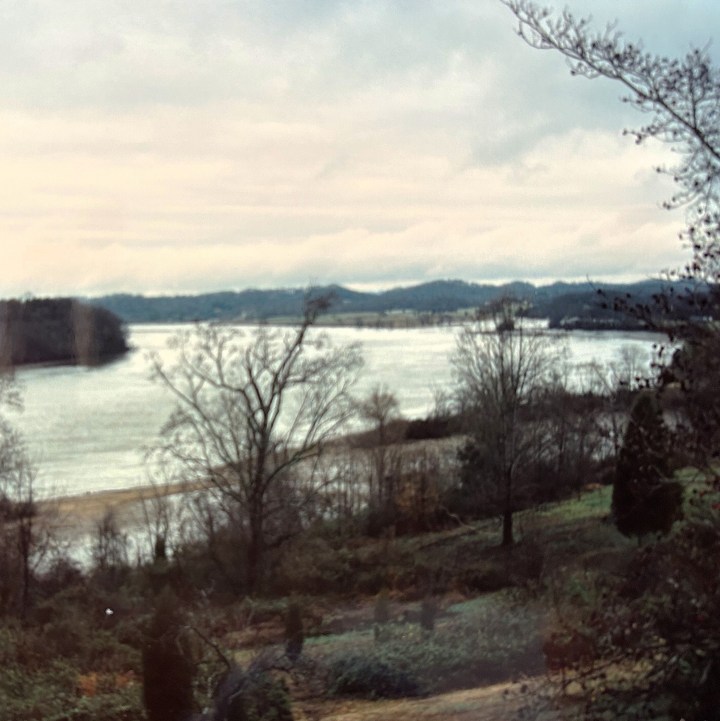
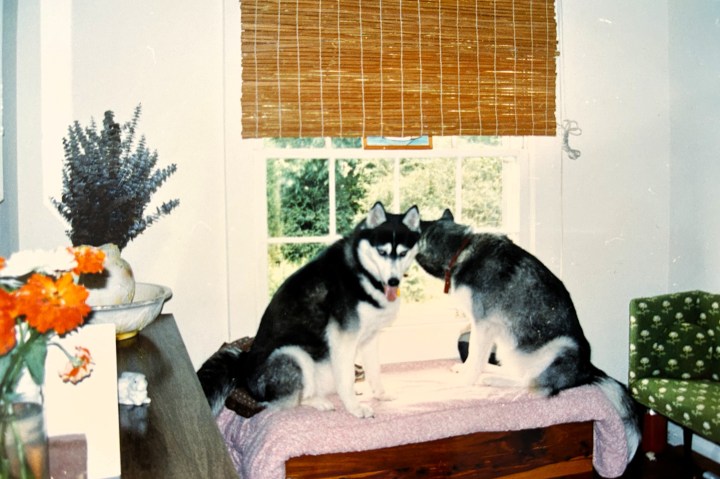
I had nothing of the kind when I was living at my great-grandmother Gracie’s house in Knoxville, Tennessee, but so much more: roughly three acres on the main channel of the Tennessee River, a slice of it at the top along a ridgeline that defined the curvilinear road down below, and the balance a graceful slope from the house gently cascading to the riverfront on the north side, fully an acre of it planted in daffodils. And not a Goldapeake retriever as company, but first one then three Siberian huskies.
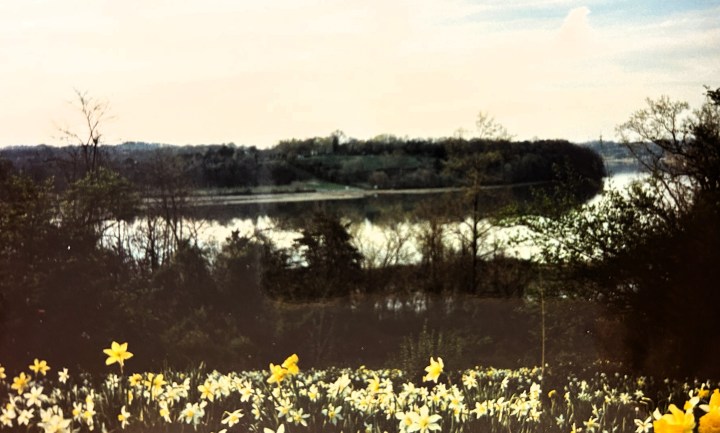
David came home from work and dropped the last of the Christmas thumb drives onto the kitchen table a few weeks ago, the oldest and fullest of them. I’ve watched the video footage on this one only once, but those moments from late 1992 and early 1993 came bubbling back up like yesterday, a fantastic record of my relatively brief tenure at Gracie’s house. I lived alone in her little white clapboard cottage for a couple of years starting in fall of 1985, and then began my married life there, my first marriage, staying through grad school and the first two years of life as a new parent, until fall of ’95. The house was wholly unremarkable in every way except its history, and that bit was extraordinary. The land there, though, is magical, and living on it was a rare privilege I did not fully appreciate at the time.
I did appreciate it at least in good measure, a truth revealed in that little thumb drive, because there is a short segment of video I made on a walkabout showing the extent of the property and noting important details along the way. Here is my 32-year-old voice (so young!) narrating the tour, pointing out to an unknown viewer what to look out for, what is dormant now but will soon bloom, what was once overgrown but has now been cleared, nodding to neighbors when I cross their properties at the shoreline, and then culminating at the dock to the east of the property on land that was once my extended family’s but by then belonged to our lawyer friend Tim. I had the wherewithal to note the mid-winter sun setting in the west before my then-husband greeted me with our three excited leashed huskies after running with them. And that is where the narrative ends.
The house was a disaster we newlyweds were trying to make better as our wallets allowed, but we were sub-par renovators at best, and anyway the place would soon grow too small after the surprise arrival of our infant boy. I had moved in at my mother’s urging when I returned to Tennessee after a three-year sojourn in Colorado. The house had stood empty and buttoned up all that time, after Granny Grace—‘Granny’ to all of us—was removed from it to live out her remaining days in a nursing facility.
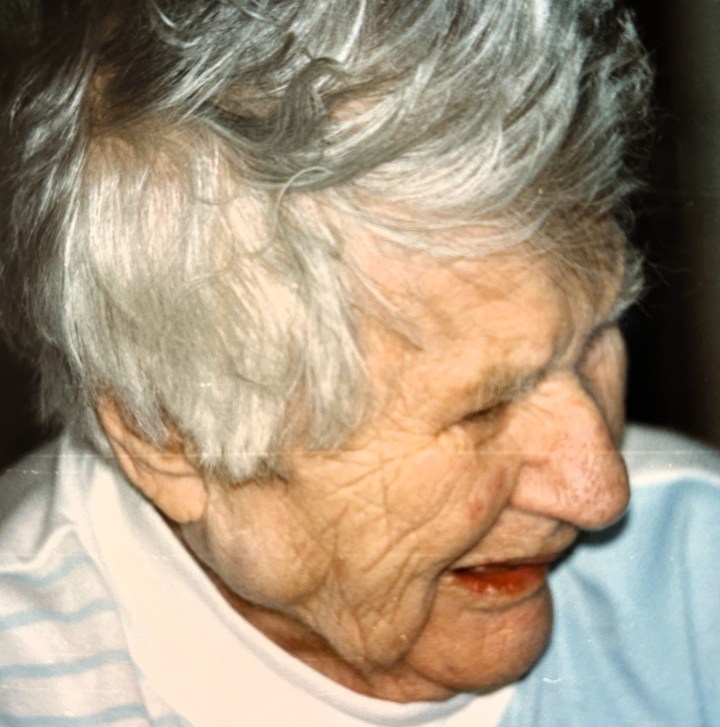
Bad things happen to an empty house. On the day I jiggled my key into the lock and turned the front doorknob for the first time, the heady stench of mold and mildew greeted me, the stagnant air an assault to the lungs. Wet carpet. Evidence of rodents everywhere. Nothing that smelt cozy or familiar, and every surface filthy. Many of Gracie’s things were still hanging in her closet or folded neatly in her chest of drawers, but a family of renters had lived in the cottage for a brief time after their house burned, so some of the furniture was not precisely arranged as I remembered it growing up.
Sadly, I discovered during my first walk-through a pair of exquisite Art Deco-era chairs in ruins. They’d been in my grandmother “Bob Mama’s” and Gracie’s home in Fort Sanders, a neighborhood just west of downtown Knoxville that defines northern boundary of the University of Tennessee campus. Bobbie was Granny’s daughter and was long gone by the time Granny lived in the cottage. Granny’d arranged the chairs downstairs in the addition she built onto the north elevation facing the river, an extension of the basement living space below, and the living room space above.
The renters had moved the chairs into storage in what Granny Grace often referred to as the “unexcavated” portion of her basement. This was an ell-shaped space accessed through a small paneled wood door, where the water heater stood and not much else, except dirt and sometimes mud, along with the granite outcropping that served as the very foundation of the house. That gorgeous furniture had been pushed inside the space to rot, quite literally, and had done so to a point beyond salvage.

You’ll want to get the power flipped on before you do anything else, advised my mom. Bad advice, turns out. What I should have done instead was deal with the water. I had only to step inside the well house—a small structure that stood on the line between this property and the adjoining larger one, where Gracie’s son John had lived with his family at one time—and then to open a small valve to allow water to flow across the property and through the pipes, thence to the water heater.
From the early days of these combined properties, when Great Smoky Mountains National Park founder David Chapman lived there, the two houses—the large ‘main’ house and Gracie’s small cottage, once a servants’ quarters—had shared the well. This was a legacy that continued through generations of owners and families.
Instead of turning on the water, though, I contacted Knoxville Utilities Board as instructed, set up a new account, and lo, there was power. Next, I tracked down one Howell Kellogg, a sketchy, skinny man my extended family had employed for many years to take care of all the things nobody has time for or wants to do. Kellogg, as he was called, had a job you could fairly call ‘grounds maintenance’ if you were being fancy. He drove a 1960s clunker pickup with empty booze bottles rattling around on the floor and a shotgun tucked behind the front seat (what could possibly go wrong). Aside from toting these objects around, he also toted my great-grandmother Gracie when she needed a ride to the White Store for her cartons of Viceroys and her five pounds of bacon for the freezer. Wouldn’t that have been a sight to see, and I swear I am not embellishing this one little bit.
It took me fully two days to track him down to help me find the valve that opened the water to the house, not unusual. Two days during which time the water heater’s upper and lower elements were on and burning dry inside the tank, until they burned out. It’s a damned miracle I did not burn down the house. So now I’d finally restored power and water but had no hot water. Nor could I have simply replaced the elements, because it turns out the tank had also filled during its longish lifetime with sediment in the lower portion, after the red, clayey soil that is native to the region insinuated itself into the water supply, effectively ruining the heater. It would need replacing, a thing I achieved much later with the help of a family friend, right after he removed one small dead rodent from the top of it. So in the intervening weeks I had no choice except to make the best of a bad situation and rely on the goodwill of a pair of elderly neighbors who made their guest bathroom available for me to bathe. Good neighbors.
The widow living in the ‘main’ house at the time, with whom I shared the well water and the driveway, was also a good neighbor who cut a fair deal with me to pay for the power. Life went on like this for several years and into my married life, until she decided the big house was too big for an individual, even if her adult children showed up for visits from time to time. So she listed it and moved into a condo in town and we bade her a wistful farewell.
Our new neighbors were also good neighbors, but emphatically wished for their own driveway, thanks. The water situation, they said, worked just fine for them, so we dodged that potentially expensive bullet. Honey and Lamar Alexander brought with them their well-behaved children and their celebrity. Lamar had served as Tennessee governor, as president of the University of Tennessee (during my undergraduate years there), and would soon be tapped by President George H. W. Bush as Secretary of Education.
We understood their need for privacy. They also financed the whole enchilada—the expensive earth moving, the underlayment, and then the surfacing. In a matter of weeks we had a shiny new driveway, if a bit tricky to navigate down to the road below, and a new fence line separating us from them; they did install a gate so we could go back and forth easily. Quite a decent gesture, but I longed for the old arrangement, the cojoining of the two properties now lost. It was theirs to own and do with as they pleased. Still, they were good famous neighbors.
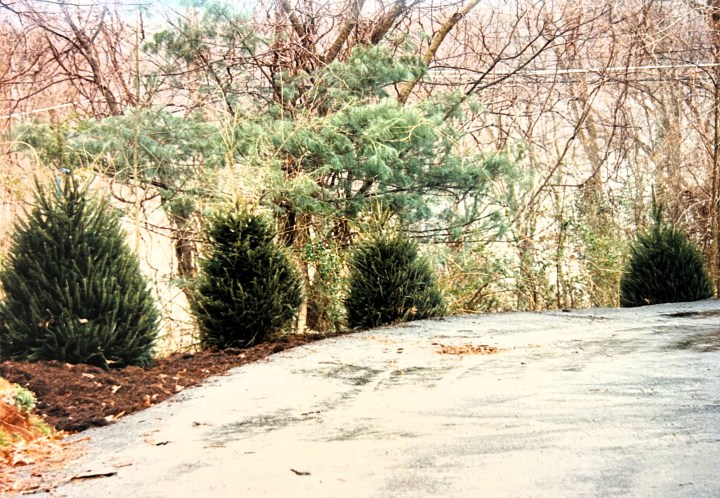
They also made substantial changes to the ‘big’ house, including a massive addition they built onto the west elevation, and the construction of a large, in-ground pool. Elsewhere they made many updates to the landscape on their spectacular property. During this period they warned us of the possibility of unintentional disruptions to water and power. Lamar handed us a phone number to dial. Just call, he said, and someone will be right with you.
This proved true. Our water disappeared one afternoon, just dried right up. Poof. We whipped out the card, dialed the number, and Lamar answered and said he’d come by himself to see what was what. Funny thing, though, this problem popped up on the same day President Bush was in town to address a crowd announcing Lamar’s new Cabinet post. (Or ‘El-mar’ as we and our neighbor Tim referred to him if we were in public, because we noticed people around us were keen to, eh, lean in.) On that day, Lamar was on his way to the airport, accompanied by a single burly secret serviceman, to greet the President.
And here he came, through the gate and across our yard, dressed to the nines in a tailored navy suit. Once he was inside our little cottage, our three eager Siberian huskies greeted him, howling in unison, their tails all awag. If you know anything about huskies you know this is the standard greeting. But try as we might, we could not keep their hair off the tailored suit, a futile exercise when one is in the company of furry sled dogs. After only a short time, Lamar was covered in Husky hair. He seemed not to care, and remained focused on the issue at hand, to get the water restored, which he managed to achieve in short order after tracking down his contractor.
We couldn’t let him go meet the President of the United States looking like that, so we walked him outside the front door and beseeched him to stand there like a scarecrow while we wiped down his suit with damp dish towels. Trust us, this works, we said. He complied, the secret service guy looking on at the spectacle with due suspicion. Who could possibly blame him.
These are the kinds of stories you can’t make up, or maybe you can, but this one is truth.
Also truth is a chapter here in Wilmington that thankfully closed last Friday after the house in back of us sold. The people who bought it a couple of years ago seemed somehow always to attract an entourage of undesirables and all that goes with that. Mainly, it was noise that seemed to start around 9 or 10pm and then continued sometimes ‘til 2 or 3am. We were compelled on these occasions to pull on our clothing and go pound on the door and ask ‘em to please knock it off. They always greeted us with surprise and then profuse apologies and compliance.
Any reasonable person would understand they’d crossed the line and would simmer down, right? These folks evidently missed that memo. It slowly dawned on us their ‘compliance’ with the basic rules of consideration were tantamount to both fingers raised at us when we turned our backs. The problem finally reached a crescendo about two weeks ago when David had a near-physical encounter with one of many booze-swilling teenagers who’d parked themselves there for the night. Cooler heads prevailed, but after that we threw in the towel and called the cops, again and again. I’m guessing they were already on a first-name basis.
The bad neighbors are now gone neighbors. It’s the thing you can’t control for, wherever you put down a tap root. An irksome truth: There are no guarantees in life.
Meanwhile in this household we’re enjoying some of the best sleep we’ve had in two years and looking forward to porch season.
I leave you with a short, poorly edited video clip of my much younger self walking my great-grandmother’s and surrounding properties in midwinter 1993. Note my reference to the Hogans. They were the family who purchased Honey and Lamar Alexander’s property.
 Carolina Thinklings
Delightful discussion of good vs. bad neighbors! We moved into my in-laws condo when they moved to assisted living. We have new neighbors who are quiet and we hardly ever see them! I’ve attempted to say hello to the husband – he’s either deaf or extremely unfriendly… I have no way of knowing!
LikeLike